Cleaning, sanitizing, and disinfecting are often used as if they mean the same thing. They do not. Each step does a different job, and knowing the difference helps your team use the right product, in the right place, without wasting chemicals or time.
Cleaning removes soil
Cleaning removes dirt, grease, and grime from a surface using a detergent and water. Its purpose is not to kill germs, but it is the step that makes every other step work. Sanitizers and disinfectants perform best on a surface that is already clean, because soil can shield germs and reduce a product’s effectiveness.
For daily work on washable floors, walls, and countertops, an all-purpose liquid detergent such as Commando Blitz covers most routine cleaning.
Sanitizing reduces germs
Sanitizers reduce the number of germs on a surface to a lower level. They are commonly used on food-contact surfaces, utensils, and equipment in kitchens, pantries, and canteens. Sanitizers must be used at the correct concentration, and some require a rinse afterward, so always follow the label.
Commando Spark is a chlorine-based sanitizer for compatible equipment, utensils, and surfaces. For hands, Commando Patrol is an isopropyl alcohol hand sanitizer with moisturizer for external use.
Disinfecting targets germs on hard surfaces
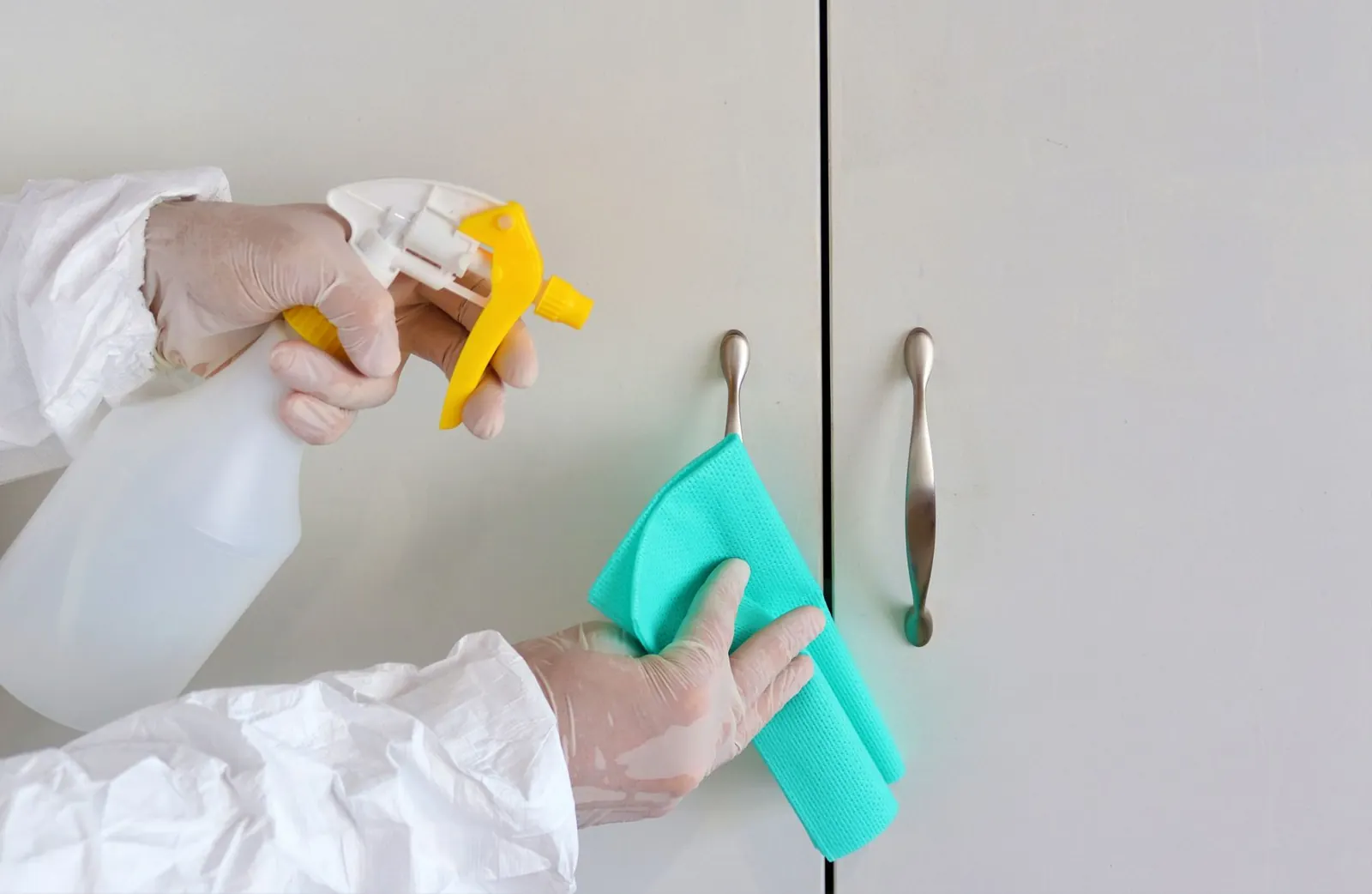
Disinfectants are formulated to act on a broader range of germs on hard, non-porous surfaces when used as directed. The most overlooked direction is contact time: the surface must stay wet for the period stated on the label. Wiping it dry too soon means the product has not had time to work.
Disinfectants are best used on high-touch points such as door handles, push plates, faucets, restroom fixtures, elevator buttons, and shared workstations. Commando Guardian is a multi-quat disinfectant for compatible commercial surfaces and equipment.
Clean first, then sanitize or disinfect
The order matters. A reliable routine looks like this:
- Remove loose debris and visible soil.
- Clean the surface with a detergent solution.
- Rinse if the label or the surface requires it.
- Apply the sanitizer or disinfectant at the label concentration.
- Leave it on for the full contact time.
- Rinse or air-dry as the label directs.
Matching products to each area
Lobbies and offices
Use an all-purpose detergent for floors and surfaces, and disinfect high-touch points on a set schedule rather than only when they look dirty.
Restrooms
Use a toilet bowl cleaner such as Commando Tornado for toilet bowls, a disinfectant for fixtures and touchpoints, and a liquid hand soap such as Commando Defend at every sink.
Kitchens and pantries
Clean first with a detergent, then sanitize food-contact surfaces and utensils. For scale and hard-water deposits on compatible equipment, use a descaler such as Commando Force.
Entrances and hand stations
Provide hand soap wherever water is available, and an alcohol hand sanitizer where it is not.
Safety basics for every team
- Never mix chemicals. Chlorine-based products can release harmful gases when combined with acids or ammonia-based products.
- Follow the label dilution. A stronger mix is not more effective and can damage surfaces.
- Wear the protective equipment listed on the safety data sheet, such as gloves and eye protection.
- Label every spray bottle or secondary container, and store chemicals away from food.
- Keep safety data sheets where your team can reach them.
Get help choosing
If you are unsure which product fits a surface or area, the Commando team can help. For product selection and quotes, call +63 998 536 0677 or email sales@commando.ph. To arrange a demonstration or staff training, email support@commando.ph.